
Frequently Asked Questions About Modular Homes
If you have any questions, want pricing for a specific home, or want a consultation, please contact or call us. We’re here to help.
-
“Modular Home” is the industry term though the official name of what we provide is technically “Factory Built Housing”. “Pre-fab” is also a term that is sometimes used but it can be used for a variety of different building systems so it is vague and not something we use. A “Modular” home is built to the California Residential Building Code, the same building code as a site built home, the only difference is that it is built in a factory and then transported to the designated location.
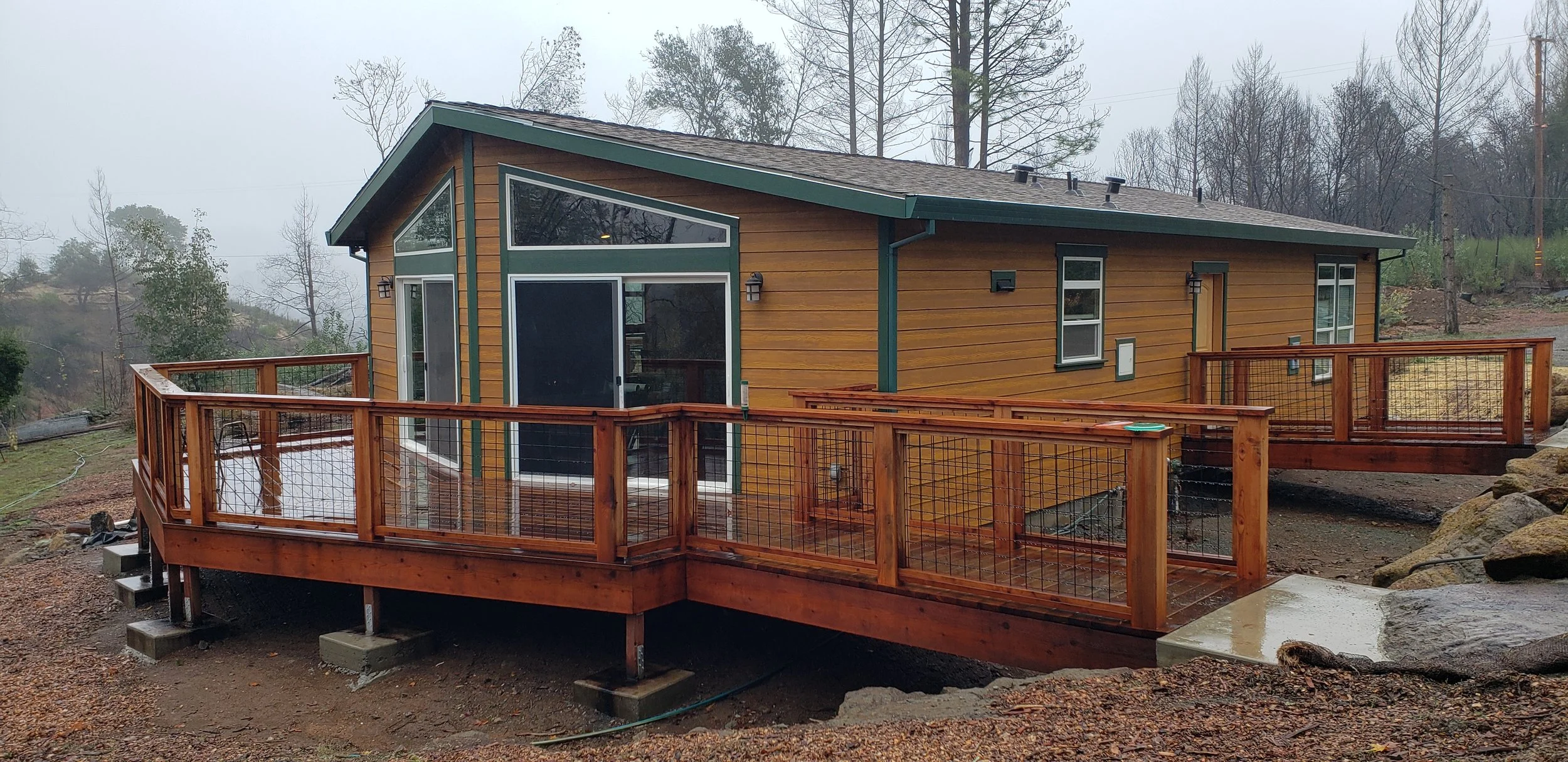
From there a licensed specialty “set crew” using a crane or sophisticated rolling equipment places each piece on a concrete foundation, and a licensed contractor completes the home. Once your home is finished, it is indistinguishable from a traditional “stick-built” home.
So, when you see someone use the term “Pre-fab” we recommend verifying that the home is being built to the California Building Code as Pre-fab can also be used for homes building to the HUD code and those are also called Manufactured homes. We do not build or provide Manufactured/Hud/Trailer homes.
We build Factory Built Homes, AKA Modulars, built to the California Building Code.
-
Our standard modular homes retail for a minimum of $235.00 Per Square Foot (“PSF”) delivered including sales tax. Modular homes generally cost 5-20% less than a comparable finished home built on-site in most areas of California, but the biggest benefit of a modular home by California Modular Houses is getting your home built faster, less stress on you and your family, better cost efficiency for the home itself, and full control over your project.
The traditional method of building is to hire an Architect and have a whole team work on your plans and then you get to bid it out to contractors. We worked with some really great people who had a stated budget of $600,000.00 for their Single Family Residence. They had their plans designed for a traditional site-built home and although everyone knew the budget in advance, it was designed without that budget in mind and the cost was $900,000.00. They had to start their whole project over with us. While anecdotal, it is rare that a week goes by that we don’t get a call from someone in exactly the same position. With our system, using an already designed plan, you will know what the cost of that home is, before even starting so you don’t find yourself in that situation.
There is site work that has to be accounted for and you will need a full set of construction documents in place to get contractors to bid that work out for you. We recommend budgeting at least 30-50% of the cost of the home for the on-site work to complete the home. We would like to see that it comes out less than that for you but it is better to over-estimate than under-estimate to make the project stress free and fun building your dream home.
If you have grading to do on the property, you are building a garage, driveway, doing septic or bringing in utilities, these costs will be additional but these costs would all be the same if you are building a home on-site, it is with the house itself where we can save you money. Also, we can introduce you to a contractor or two who understands our building system and appreciates the fact that they can walk into a project where the plans are done and everything is detailed so they do generally provide better pricing for the on-site work than would a random contractor.
While we get this question daily, we are not able to provide you with a final cost of your entire project, that does have to be provided by the contractor once plans are in place. The best ways to keep your budget in check are to keep it simple and to build only what you will need for as long as you are going to be living in your home.
Once you have site-specific engineered plans in place a licensed General Contractor can provide you with an estimate for the on-site work. California Modular Houses is not a construction company and doesn’t estimate or perform on-site work.
While our modular homes are normally less expensive than site-built homes, the homes will not be as cheap as manufactured or mobile homes, as our quality standards are much higher and the cost is more. We typically tell our clients that if they can’t afford at least $300.00 per square foot for their vertical construction costs (hard costs from the foundation up, on a level lot, not including permits, utility connection costs, permits, fees, or engineering), they probably cannot afford our more value-conscious modular homes.
The pricing noted above is for a standard-sized single-story home of about 2000 SF efficiently designed to be built in the factory and transported to your property. As homes get less efficient or smaller, the cost does begin to increase on a PSF basis.
Our single-story homes cost less than our two-story homes for the factory-built home portion, and this also has proven to be the case for the on-site work performed by contractors (others). If your budget is a primary concern, we recommend looking at the single-story homes to help keep your costs inline with your expectations.
If you would like specific pricing on one of our homes, please reach out to us and we would be happy to put together a formal estimate for you for the home delivered, including tax and transportation.
Financing Options:
If you lost a home in a fire, then the insurance will typically provide you with a check and then you can use that to purchase your home.
If it’s an Accessory Dwelling Unit (ADU) then most people take out a home equity line of credit to pay for the building of their small home.
Many of our clients have paid cash over the years, that is always the easiest way.
If you require financing, the easiest way is for us to sell the home directly to the on-site contractor and then he can provide an all inclusive contract to you and your financial institution so you can obtain the loan required (for your contractor to be able to provide pricing for the on-site work you will need a full set of plans that has been reviewed by the local jurisdiction to make sure that everything is included in the financing).
-
Pick a Stock Plan that is in our CAD / computer drawing system. Stock Plans can be engineered for your site faster than a new custom plan. Selecting from these plans is one of the few ways you can simplify the building process, and we pass on the savings to you. Building with California Modular Houses is already easier than your other choices but building in California can be complicated. We encourage our clients to consider ways to make it easier, faster, and more economical.
Using a plan where someone has already put in the money, time, and effort to get it drawn up will simplify the process and have you living inside of your new home much more quickly… with a few extra thousand dollars in your pocket. These specials apply to modular homes built in California only.
-
California Modular Houses is a design oriented company and we design new plans all the time. We are able to work with you to design any style of home that you desire. We can adapt existing plans from our Plan Collections or work with our designers to create your dream home. We are experts at working with clients and their architects to design and engineer a custom home that is efficient, practical, and looks as good or better than a home built by the slow conventional method. It should be noted that custom designs take longer, cost more, and make an already complex process even more complicated for everyone involved. If you are on a tight budget we actively discourage our clients from choosing to custom design a home.
Typical Paths ForwardYou can choose a stock plan with no changes to keep your costs to a minimum.
If you want to customize a plan, just mark the plan up in red on the changes you require and email that to us and we would be happy to review it for you.
Provide us with the lot constraints and your requirements and we can discuss a Design Fee for drawing up a brand new plan that meets your needs, without breaking the bank.
Provide us with your list of requirements and we can design something with the footprint you require, the proper square footage as well as the bedroom & bathroom count and other considerations to meet the needs of you and your family.
-
Consultations: We can provide a consultation in a variety of different ways.
If you would just like to talk to us on the phone, you need only give us a call and we will be happy to guide you in the right direction.
If you have an idea or want to share with us your ideas, thoughts, property information, etc. then we can do a screen share online with you and we’d be pleased to know more about your project.
The Modular Feasibility Study is where there is a small cost for us to come to the property. Prior to us coming to meet you and viewing the property, we would love for you to put together a list of all of your questions and we’ll answer them all while we are there reviewing your property and the access for the modules.
-
Building a modular home will take approximately half of the construction time of conventional construction. Because the modular home is built in the factory concurrently with the grading and construction of the foundation the overall construction schedule is sped up tremendously.
Prior to the building of a home, there is a process to prepare property-specific construction plans. After that, the permitting process takes over and the timeline is based upon their schedule and the number of revisions they require to the plans. The plan preparation and permitting process is a multi-month process that is done before you break ground on your property. Building a site-built home requires these same types of timelines for plans and permits though sometimes our process is faster.
Everybody has heard how difficult permitting can be where they want to build as the California Building Code is challenging and each jurisdiction has its nuances. We recommend starting on your plans as soon as possible as there is no way to predict how fast permits will be issued.
Really though, it is the actual building of the home that is faster. We have all seen homes that are being site-built and here they are after a year or two still not finished, and that is after they went through the entire planning and permitting process.
For more information on financing, you can read more about Construction Loans, Home Equity Lines of Credit, and Other Loan Programs on this page: -
We service the entire state of California as a supplier of modular homes.
We only build homes for California. Building in California is what we are experts in and we focus on what we know and are qualified and experienced to build.
The Principal and the team of the California Modular Houses has over 30 years of combined experience helping people to build modular homes in the state. We can absolutely assist with your California home building project.
We have built homes in scores and scores of jurisdictions around the state, all the way from the coast to the mountains, from San Diego to near the Oregon border.
-
Our homes are built to comply with the Title-24 energy calculations which equates to the energy efficiency of the home. These state mandated requirements require that your home is well insulated and even that the insulation is installed a certain way for maximum efficiency. These requirements also have minimum efficiency requirements for windows, electrical, etc.
CalGreen is another state mandated requirement which is to make sure that the home is built as healthily as possible to minimize impacts on your family’s health, unlike homes built in past decades which are known to contain VOC’s and other toxic chemicals.
In short, building a home to today’s building code will provide you with the most efficient and healthiest home possible, even better than something built only five years ago.
-
We do not have a temporary “model home center” as is common in the manufactured housing industry as we only build permanent homes which are permanently attached to a concrete foundation, never to be moved again.
We respect the privacy of all of our clients and we will not ask them if someone can show up at their door for a tour. Yet, with some basic information from you, we can usually find a home that you can discreetly drive-by if you want to see a home in person. For most of our clients, the hundreds of images on our web-site does show far more than a drive-by or one or two homes though.
Where our clients seem to enjoy going most is to the factory. It is great to meet the people that will build their home. Being able to see a few different models at various stages of completion clearly shows the attention and care that goes into every one of our homes.
We do announced tours through our newsletter from time to time. Sometimes the tours are when the home is being delivered, or when it is completed. All tours are by appointment only.
So, we do have completed homes that you can view from the exterior on a discreet drive by of the property. Please fill out the Contact Us form on our web-site and provide us with your contact & location information so we can talk about you driving by one of our completed homes.
-
No. It would violate California’s Factory-Built Housing Law to discriminate against modular construction versus other techniques. California Dept. of Housing and Community Development “Factory Built Housing Guide – Handbook for City / County Building Departments” has this to say:
“Factory-built housing can be installed where other similar types of housing units are built or exist. HSC Section 19993 allows local governments to exercise their local land use requirements with respect to factory-built housing, but the Attorney General has ruled that local governments may not require use permits for factory-built housing built in residential areas. Local requirements imposed on factory-built housing may not differ substantially from requirements imposed on other residential buildings of the same size.”
-
No, you will not. We do have to meet all of the Zoning codes that apply to a site built home, but the Building Department review of a modular home is streamlined. Sometimes you will run into a planner at the City that doesn’t know what a Factory Built Home is but it’s usually resolved quite easily with an email or a phone call. Regardless of what an individual at the building or planning department may say, the stringent California state law preempts local building department permitting requirements. You will not be required to go through a complete engineering “Plan-Check” that similar site-built homes must go through or pay engineering “Plan-Check” fees, because the state of California has already performed the “Plan-Check” function during the approval process for your home. The local building department plan checks portions of the project that are done at the job site only.
The tool that we use to get our homes permitted quickly is the “California Factory Built Housing Guide for City/County Building Departments.” Check out this document if you want greater insight into why our homes are regular homes, just like site built homes.
Important Notes *** When building a modular home there is a required state-level review of the engineered plans representing what is built in the factory. Each model requires plans specific to the design and location it will be installed. This process coupled with the local plan check of the entire project negates any time efficiency in the permitting process versus stick-built construction. You can gain major efficiency in the construction process. However, our experience has been that the overall modular home permitting time frame is not shortened vs. site-built construction permitting. There is still a benefit to the modular home engineering process because it does minimize local plan check comments & revisions for the modular home itself. This takes out a lot of the guesswork and stress associated with the typical local review of plans of a site-built home. That said, we still recommend starting long before you plan on moving into your home as many local jurisdictions are back-logged and the building code to develop a new site does have a lot of stringent requirements. Once the plans are submitted, there will always be at least a couple of rounds of plan check comments, either requiring modifications to the plans for the site, or additional documentation.
-
Since a modular home is built to meet or exceed the same standards as a home built on site, it should appreciate at the same rate as a comparable site-built home. Unlike manufactured or mobile homes, a seller of a modular home does not have to keep a state or federal insignia on the home stating that it was built in a factory. The national appraiser’s guideline does not have a designation for a modular home versus a site-built home. Each of our buildings are permanent, regular homes. Fannie Mae’s “Selling Guide: Factory-Built Housing: Modular, Prefabricated, Panelized, or Sectional Housing” explains the appraisal and comparable property requirements when an appraiser values a modular home.
The state of California considers a modular home, known legally as “Factory Built Housing,” to be fundamentally the same as a home built on site. The legal department at the California Department of Real Estate (DRE) has said that if their lawyers were real estate agents in the field, they would not disclose that a home was built using modular construction methods at resale, because you only disclose negative items.
A modular home is simply a “Single Family Residence.” Future sales of the developed property will be registered as fee-simple real estate. From a legal standpoint, the only difference between modular construction and stick-built construction is during the construction phase. At completion, each construction method renders an equal home from a legal, regulatory, insurance, and appraisal standpoint.
A home built on a more modest budget will look like a stick-built home built on a modest budget, and a home built on a larger budget will look like a custom stick-built home built with a larger budget.
We do have examples of some of our homes that have since been sold since they were built and you will see that the valuation of these homes is quite comparable to that of neighboring homes.
-
Many of our homes show a garage either on the floor plan or on the elevations. What is represented in the pictures or renderings is just one way that the garage might be done. Your garage can be attached or detached from the home and can be done in a variety of sizes and styles. Garages are big empty spaces and do not have a floor system that can be used for transportation to the site. A garage is more economical to build at your property and therefore almost always is built on-site. California Modular Houses would be happy to order optional materials for you that can be used to finish your garage so it matches your home. Similarly, many of our homes show decks, porches, dormers and other features that are best built on-site by the General Building Contractor since those components are economical to complete once the home is delivered.
-
Homes can be ordered to just about any finish level that you want. Our homes usually come standard with limited-lifetime composition shingle roofing and non-combustible fiber-cement siding with a 9 foot ceiling and a 4/12 roof pitch. The cabinets, countertops, lighting fixtures, switches, plumbing fixtures, heater, ducting, drywall, etc. are all usually installed within the home prior to delivery. Yes, the home even comes with the kitchen sink.
To view our Prefab Modular ADU Specifications for California, please click here.
For our Single-Family Residence Prefab Modular Specifications for California, please click here.
We have provided a variety of elevations on our website to show different ways that a home might be finished. The standard look of our homes is a Craftsman style though we can help you to come up with just about any look that you require. California Modular Houses does not build to one style. We build the home to the style, specification, and preferences of each of our clients. The best thing to do is start with a floor plan that fits your property, suits your needs, and works with your budget.
Some of our elevations and renderings show things like cedar siding, dormers, transom windows, stucco, metal roofs, decks, porches, and balconies. These items are either factory options or done on-site. Please contact your California Modular Houses sales representative for our current specification list.
-
We are not a construction company and we do not perform on-site work. You can work with a qualified local contractor of your choosing or we can introduce you to a licensed contractor who would provide you with pricing directly (not mark-up from us).
-
Of course! All of our homes come with a 10 year structural coverage and a one year system’s coverage, the same type of warranty that site built contractors offer, as required by the State of California. We do encourage our clients to purchase an extended home warranty through the company of their choice just to prevent future surprises, not because we expect there to be any issues with your home but because we want you to be 100% happy with your home in the event of any future mishaps or damage to your home.
-
We are not a real estate company and that is not something that we do. Typically it is best to drive around where you want to build, search the MLS, or contact a local realtor who can help you find the exact property that is right for you. We do recommend finding a property where you can build fairly close to the road and one that doesn’t require a lot of grading to help keep your costs down, having utilities already on the property is not that common but it is something to look into as sometimes someone has already spent money working on that which will keep your costs reasonable and help to prevent delays.
-
Preliminary calculations are of the exterior of the building area as per industry standard, exterior framing to framing. The approved construction documents will show the final dimensions.
-
We only sell real homes, known as “Single Family Residences.” All of our homes are built to the California Residential Code, the State of California’s code for real homes. We don’t sell any mobile homes or manufactured homes, so please don’t worry! We are using an advanced way of building homes, not building trailers. These are regular homes, built in components in the factory and assembled on-site, but become indistinguishable from conventionally-built homes when completed. The financing is the same type of construction or permanent financing that you get with any other home. Your home will appraise like a similar stick-built home on a similar lot with similar amenities, not like manufactured housing.
Please don’t take just our word for it. The Federal National Mortgage Association (FNMA), or “Fannie Mae,” provides liquidity, stability, and affordability to the mortgage market. Its purpose is to create a secondary market for the purchase and sale of mortgages, so it is the most credible source that you can go to about the sale and financing of modular homes. Please see the Fannie Mae “Selling Guide: Factory-Built Housing: Modular, Prefabricated, Panelized, or Sectional Housing” here.
Read a technical comparison between modular and manufactured homes here.
-
Yes, we do. Yet, on most mult-family projects, to maximize the investment, stock plans do not work. We can introduce you to a surveyor and civil engineer who can help lay out your site to address parking and the local requirements to determine what can be built and help you put together a strategy for your property. A consulting fee may be required for multi-family projects, depending upon the exact scope of work required of us to assist you to move forward.
-
Accessory Dwelling Structures, ADU’s.
Single Story Residences
Two Story Homes
Cape Cod Models
Multi-Family Structures
-
There are many benefits to building a modular home instead of a site built home. The main reason that people come to us is that the cost of building where they are is too high to build on-site. Yet, there are other over-looked reasons to build a modular home.
Excellent cost controls in place for the home itself.
Plans for the Factory Built Home are a credit on the price of the home rather than an additional cost like with a site built home.
We have good relationships with different professionals that we will introduce you to directly so there is no mark-up from us. These companies appreciate working with our clients and provide fair pricing for quality work.
Building in California is not fast, but building a modular home is usually notably faster than building on-site, from start to finish.
One of the biggest benefits, and the one that is most overlooked is that a modular home is more defined and you aren’t starting from a blank slate, you are working with a modular plan, one that you know the cost of before you get very far or invest a lot of money, and since the process is easier, it makes building a modular home much less stressful than starting from scratch and then finding out what you got yourself into.