I can’t get a clear answer, what is the real difference between a modular and manufactured home?
Manufactured Homes compared to Modular Homes
Many people interested in building their home do not get accurate information when they try to learn the difference between modular and manufactured homes. I would like to help explain the difference between these two options that you may consider when building a home.
Manufactured Homes (mobile, trailer, HUD home):
1. The home is delivered on an integral steel frame (chassis) and must remain on this steel frame forever.
2. There is a permanent identifying plate that has to stay on the home, like a license plate. This is a relic requirement from when it used to be a true mobile home pulled from place to place.
3. HUD homes have low-pitched roofs, typically 2/12 or 3/12, and rarely something even like a 4/12, because of architectural design limitations.
4. The quality of the materials is not the same as that of site-built or modular homes in most cases. To keep the cost low, most builders of HUD homes use suppliers that have designed products specifically to be the cheapest that can possibly be built and meet the HUD code.
5. HUD homes are built to a blanket federal code, not your local building codes.
6. In most cases a HUD home will finance more like personal property, similar to a car. In some cases it can be financed as a “Mobile Home on a Permanent Foundation.”
7. There is a required disclosure when you sell a manufactured home since it's not the same building code as a site built home or a modular home.
8. Refinancing is more difficult in almost every case, given similar income, credit, and loan amounts.
9. It is difficult to make changes to a manufactured home because it requires a state inspector to review plans and come do site inspections. Since the HUD homes are designed to the minimal structural code allowed in most cases, your options are typically limited to minor changes or side-to-side additions. Two-story additions are uncommon (nearly impossible).
10. There are very few two-story manufactured homes, and those that are built have a very simple look to them.
Manufactured/trailer/mobile/HUD homes are in fact cheaper than modular homes as a general rule, and about the same or faster to install than modular homes because of their architectural and structural simplicity. It has been our experience that many people think manufactured home finishes are cheap looking and feeling, and they commonly spend a bunch of money upgrading it to look like a real home. Buyer’s usually realize later that the cost comes out to something similar "all-in" like what they would have spent on a modular home, but without the same value creation as is possible when building a modular home.
Modular Homes (Pre-fab, Factory Built Housing):
1. The home is built on wood floor joists or floor trusses above a raised perimeter concrete foundation, just like any other site-built home on a raised foundation. A big difference is that the floor has double rim-joists whereas a site-built home would only have single rim-joists.
2. There is no such obvious permanent plate telling anyone that you are living in a mobile home. The most typical indicator is a sticker that is placed on the inside of a bathroom or kitchen cabinet. This sticker may removed upon completion of the home.
3. The roof pitch can be pretty much whatever you want it to be. You can build a flat roof, a 2/12 or 3/12 Spanish style roof, a standard 5/12 or 6/12 ranch, and even up to a 12/12 Cape Cod or Lodge style roof. Multiple gables, hips, and roof pitches are possible.
4. The quality and performance of the home’s structure generally exceeds that of a site built home and is much, much stronger than a manufactured home.
5. Modular homes are built to the same state and local building codes as site built homes.
6. The construction loan finances a modular home just like a site built home.
7. There is no disclosure required at the time of sale since the modular home is just a different route to building a Single-family residence, not a different type of home. Feel free to verify with this with your state Department of Real Estate if you don't believe us.
8. Refinancing is the same process as with a site-built home.
9. It is not hard to make changes to plans. Many of our homes have been custom designed for our clients, and are specific to their needs, the configuration of their lot, and the requirements of the local jurisdiction. For example, If you want to add on later on, you will have the plans for the modular home and you can hire a team to design your addition.
10. Wood-framed modular homes can be two stories or three stories. Four story modular buildings are possible in low seismic and wind conditions. We can ship modular buildings for apartments and condominiums up to five or six stories tall using wood-framed construction, built to the appropriate building code.
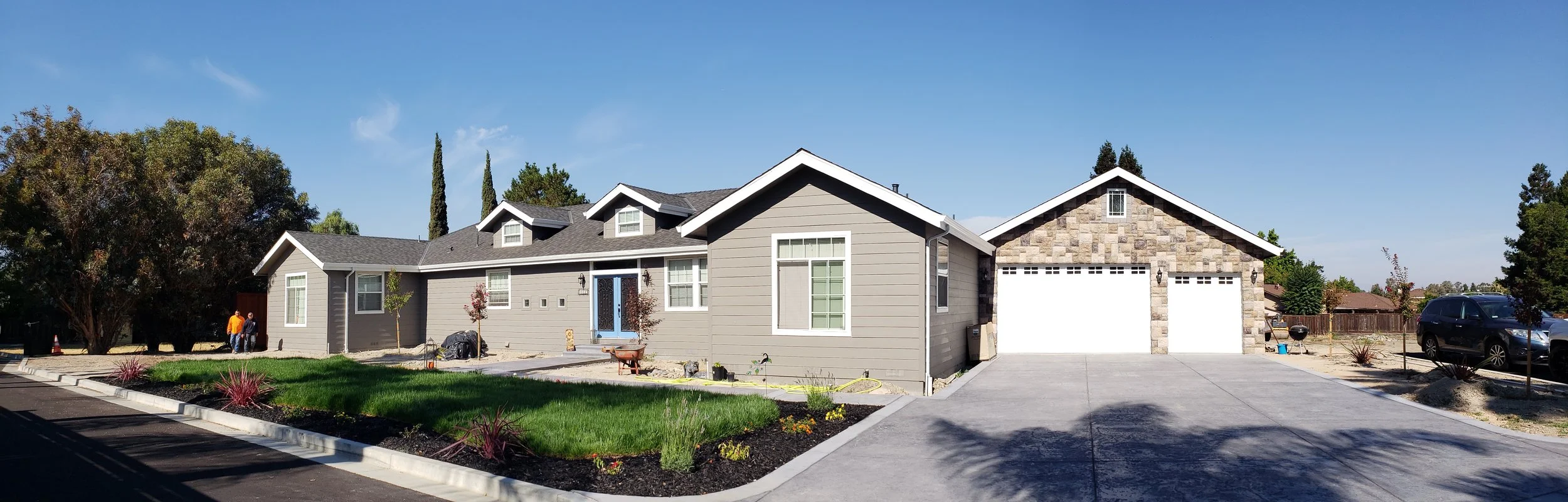
A regular site-built home typically has 2" x 4" exterior walls, even in many fancy neighborhoods. Modular homes have 2" x 6" exterior walls standard, better than most site-built homes and almost all manufactured homes. If you want to buy a home that is built almost as fast as a manufactured home but holds its value and looks like a regular stick-built home, you want a home provided to you by California Modular Houses, Inc.
Steps to Build a Modular Home in California
Check out our FAQ page read more in-depth answers to the most commonly asked questions about modular homes.
Step 1:
Secure Land
Having a property is usually the first step in building your dream home.
Without land, it is hard to choose a home model or determine what the balance of your budget for building is.
Step 2:
Modular Feasibility Study
This is where one of us comes out to meet you at the property and determine what size modules can be delivered.
There is a fee for this service but it’s a credit on the price of the home.
Step 3:
Choose Home Model
We now know what size modules can be delivered. You can choose a home model that meets your requirements. Start with the smallest one you will consider and work your way up to your dream home.
More detailed info about building California
Check out our Modular Steps to Building page for more detailed information about building a modular home throughout the state of California.
Step 4:
Working on Plans
This is where you start working with us on the plans for your Factory Built Home (Modular).
There are costs involved in the modular home plans but they are a credit on the price of the home.
Step 5:
On-Site Pans
You will needs some plans for the on-site portion of the project:
Topographical Survey
Civil Engineered Site Plans
Soils Report
Foundation Plans, etc.
Step 6:
Permitting
Now that your plans are completed it is time for submission. We have an Optional Permitting Service or we can introduce you to someone to help you.
Expect plan check revisions, rarely do plans get approved on the first or second submission.
Home Floor Plans & Pictures to Review
Take a look at hundreds and hundreds of images and floor plans of our homes. Your home can look exactly how you want it, you are only limited by your imagination & budget.
Step 7:
Contractor Interviews
We do know a few General Building Contractors that we can introduce you to. They are familiar with modular home and can certainly help you.
Sometimes though you may have a qualified local contractor you’d like to work with, this is also your decision to make.
This is one of the most exciting parts of building a modular home. You get to see all of your hard work being delivered to your property.
You get to sit back, take pictures, and watch the show.
Then you get to walk through your house!!!
Step 8:
Modular Home Delivery & Set
Step 9:
Completion of Modular
Your General Contractor will work to secure the modules to the foundation, connect the cross-overs, finish whatever on-site work there is, etc..
From there, the City/County will review and provide your Certificate of Occupancy. Time to move into your dream home!
Congratulations!!!
Map Addresses Are Intentionally Approximate to Protect the Privacy of our Clients.